Showing posts with label methodology. Show all posts

Monday, June 2, 2014

Kaggle tips to avoid pitfalls in Machine Learning

"At Kaggle, we run machine learning projects internally and also crowdsources some projects through open competitions. We’ll cover the gritty details of the most fascinating competitions we’ve hosted to date, from optimizing early stage drug discovery pipelines to algorithmically scoring student-written essays, and explore the methods that won these problems.

After working on hundreds of machine learning projects, we’ve seen many common mistakes that can derail projects and endanger their success. These include:

- Data leakage
- Overfitting
- Poor data quality
- Solving the wrong problem
- Sampling errors
- and many more

In this talk, we will go through the machine learning gremlins in detail, and learn to identify their many disguises. After this talk, you will be prepared to identify the machine learning gremlins in your own work and prevent them from killing a successful project."


sources:
http://strataconf.com/strata2014/public/schedule/detail/32168
https://www.youtube.com/watch?v=tleeC-KlsKA

Agile + Big Data

Interesting post about Agile + Big Data projects:

http://strata.oreilly.com/2014/05/how-to-be-agile-with-your-big-data.html

Monday, May 26, 2014

Prediction APIs - Automating Data Scientists Tasks

It's time to start automating data science tasks.

Nowadays, most of data scientists spends too much time choosing best set of features, finding the right algorithm and tuning parameters.

Imagine if data scientists had one tool or one service that could find out best set of features and the best algorithm using optimal parameters.

We are already seen some companies claiming these capabilities, they called it as: prediction API.  Some examples are:


Although, I believe that an experienced Data Scientist will always be able to improve the work of any automated tool/process, the prediction API will automate lots of tasks done by Data Scientists, so, what should data scientists do on that time?

  • focus on preparing the data (collecting/enriching/cleaning it/wrangling it)
  • focus on feature engineering, translating business understating in features and integrating them in your dataset (in my point of view, that's the most important task)
  • focus on studying the core concepts, intuitions and possibilities of machine learning, and some key examples.

Checkout these articles:
http://gigaom.com/2014/05/07/the-goal-of-data-scientists-is-to-put-themselves-out-of-business/
http://gigaom.com/2014/04/09/this-startup-says-it-can-find-the-algorithm-that-defines-your-data/
http://strata.oreilly.com/2013/08/data-analysis-tools-target-non-experts.html

Friday, May 23, 2014

Typical steps of analytics projects

I read the article on: http://inside-bigdata.com/2014/05/23/introduction-machine-learning/

It's not exactly an article, there are lots of commercial offering from Revolution R (that seems to be a good product, although I never tested it). They described quite well the main phases and some challenges of one analytics project.

I liked list of phases below:

An also liked the description of some steps involved on data preparation before statistical modeling phase:
Data Access:
The first step in a machine learning project is to access disparate data sets and bring them into the your environment

Data Munging
The next phase of a machine learning project involves a process called “data munging.” It is often the case where the data imported into your environment is inconvenient or incompatible with machine learning algorithms, so with data munging (also known as data transformation) the data can be massaged into a more hospitable form. Data munging cannot be taken lightly as many times it can consume up to 80% of the entire machine learning project. The amount of time needed for a particular project depends on the health of the data: how clean, how complete, how many missing elements, etc. 
The specific tasks and their sequence should be recorded carefully so you can replicate the process. This process becomes part of your data pipeline. Here is a shortlist of typical data munging tasks, but there potentially are many more depending on the data:
  • Data sampling
  • Create new variables
  • Discretize quantitative variables
  • Date handling(e.g. changing data types)
  • Merge, order, reshape data sets
  • Other data manipulations such as changing categorical variables to multiple binary variables
  • Handling missing data
  • Feature scaling
  • Dimensionality reduction

Exploratory Data Analysis
Once you have clean, transformed data inside the R environment, the next step for machine learning projects is to become intimately familiar with the data using exploratory data analysis (EDA). The way to gain this level of familiarity is to utilize the many features of your statistical environment that support this effort — numeric summaries, plots, aggregations, distributions, densities, reviewing all the levels of factor variables and applying general statistical methods. A clear understanding of the data provides the foundation for model selection, i.e. choosing the correct machine learning algorithm to solve your problem.

Feature Engineering
Feature engineering is the process of determining which predictor variables will contribute the most to the predictive power of a machine learning algorithm. There are two commonly used methods for making this selection – the Forward Selection Procedure starts with no variables in the model. You then iteratively add variables and test the predictive accuracy of the model until adding more variables no longer makes a positive effect. Next, the Backward Elimination Procedure begins with all the variables in the model. You proceed by removing variables and testing the predictive accuracy of the model.
The process of feature engineering is as much of an art as a science. Often feature engineering is a give and-take process with exploratory data analysis to provide much needed intuition about the data. It’s good to have a domain expert around for this process, but it’s also good to use your imagination. Feature engineering is when you use your knowledge about the data to select and create features that make machine learning algorithms work better.
One problem with machine learning is too much data. With today’s big data technology, we’re in a position where we can generate a large number of features. In such cases, fine-tuned feature engineering is even more important.


source: http://inside-bigdata.com/2014/05/23/introduction-machine-learning/

Wednesday, May 21, 2014

Social Data Revolution - Andreas Weigend (former Amazon Chief Data Scientist)

Andreas Weigend is former Amazon Chief Data Scientist and now he teaches at Berkeley and Stanford.

He created course, articles and youtube channel about what he call as "Social Data Revolution".

I watched some videos (below) and this presentation (http://weigend.com/files/speaking/Weigend_IAB-WOBI_MIL_2013.12.04.pdf), and here are key points I marked from his thoughts:

Data Rules:
Rule #1: Start with a question, not with the data
Rule #2: Base the equation of your business on metrics that matter to your customers
Rule #3: Focus on decisions andactions, and design for feedback
Rule #4: Embrace transparency: Make it trivially easy for people to connect, contribute, and collaborate

Create data to solve your problem, mindset is the most important part:


5 stages of Amazon Recommendations:
  1. Manual  (Experts)
  2. Implicit  (Clicks, Searches)
  3. Explicit (Reviews, Lists)
  4. Situation (Local, Mobile)
  5. Connections (Social graph)


Social Data Revolution
Billions of people socialize "their" data with friends, companies, and the world. This irreversible cultural shift, the Social Data Revolution, has transformed how we view our friends and ourselves (as well as our shoes). Social data influence our purchasing and lifestyle decisions. Companies and governments now observe our decisions and how we got there. So, your shoe selfie is also a clue for today's data detectives as they piece together your digital footprint.

About Andreas Weigend
Dr. Weigend was the Chief Scientist at Amazon, where he focused on data strategy and customer centricity. He is an advisor to startups around the world, and a consultant to established companies including Alibaba, Lufthansa, and MasterCard. He teaches at Berkeley and Stanford, and directs the Social Data Lab. He is also a limited partner at Founder's Fund.


sources:
http://www.weigend.com/sdr/
http://weigend.com/files/speaking/Weigend_IAB-WOBI_MIL_2013.12.04.pdf
http://www.youtube.com/watch?v=3INyk-Up_LY&list=UUkdjJNKqfG0idaTaahWiUCw
http://blogs.hbr.org/2009/05/the-social-data-revolution/

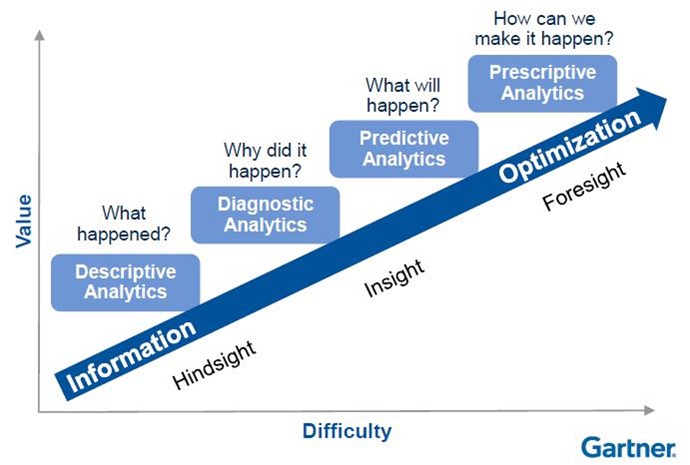
Analytics Maturity Capabilities

Gartner Analytic Ascendancy Model (I also understand as Analytics Maturity Capabilities):


sources:
http://timoelliott.com/blog/2013/02/gartnerbi-emea-2013-part-1-analytics-moves-to-the-core.html
http://meetings2.informs.org/analytics2013/Advancing%20Analytics_LKart_INFORMS%20Exec%20Forum_April%202013_final.pdf
http://www.rosebt.com/blog/descriptive-diagnostic-predictive-prescriptive-analytics

Design Thinking + Data Science

Nice story using Design Thinking on Big Data projects.

follow link below:
http://strata.oreilly.com/2013/10/design-thinking-and-data-science.html

Methodology - CRISP-DM

CRISP-DM (Cross Industry Standard Process for Data Mining) [1] is a data mining process model that describes commonly used approaches that data mining experts use to tackle problems. Polls conducted in 2002, 2004, and 2007 show that it is the leading methodology used by data miners.


Business Understanding
This initial phase focuses on understanding the project objectives and requirements from a business perspective, and then converting this knowledge into a data mining problem definition, and a preliminary plan designed to achieve the objectives.
Data Understanding
The data understanding phase starts with an initial data collection and proceeds with activities in order to get familiar with the data, to identify data quality problems, to discover first insights into the data, or to detect interesting subsets to form hypotheses for hidden information.

Data Preparation
The data preparation phase covers all activities to construct the final dataset (data that will be fed into the modeling tool(s)) from the initial raw data. Data preparation tasks are likely to be performed multiple times, and not in any prescribed order. Tasks include table, record, and attribute selection as well as transformation and cleaning of data for modeling tools.

Modeling
In this phase, various modeling techniques are selected and applied, and their parameters are calibrated to optimal values. Typically, there are several techniques for the same data mining problem type. Some techniques have specific requirements on the form of data. Therefore, stepping back to the data preparation phase is often needed.

Evaluation
At this stage in the project you have built a model (or models) that appear to have high quality, from a data analysis perspective. Before proceeding to final deployment of the model, it is important to more thoroughly evaluate the model, and review the steps executed to construct the model, to be certain it properly achieves the business objectives. A key objective is to determine if there is some important business issue that has not been sufficiently considered. At the end of this phase, a decision on the use of the data mining results should be reached.

Deployment
Creation of the model is generally not the end of the project. Even if the purpose of the model is to increase knowledge of the data, the knowledge gained will need to be organized and presented in a way that the customer can use it. Depending on the requirements, the deployment phase can be as simple as generating a report or as complex as implementing a repeatable data mining process. In many cases it will be the customer, not the data analyst, who will carry out the deployment steps. Even if the analyst deploys the model it is important for the customer to understand up front the actions which will need to be carried out in order to actually make use of the created models.

source:
http://en.wikipedia.org/wiki/Cross_Industry_Standard_Process_for_Data_Mining

The Data Scientific Method

Data Scientific Method

  1. Start with a Question
  2. Leverage your current data
  3. Create features and run tests
  4. Analyze the results and draw insights
  5. Let the data frame a conversation


source: http://datascience101.wordpress.com/2012/06/27/the-data-scientific-method/#comments